

Aerospace, Aviation & Defense Flooring Systems
Aviation hydraulic fluids, fuel drips, deicing fluid tracked in on the gear, tug and jack-point loads, and the static-sensitive electronics rooms next door. One campus, six different floors. Maverick engineers each zone of an aircraft maintenance, repair, and overhaul (MRO) operation, aerospace component plant, or military maintenance depot to the fluids and loads it actually sees.
One Campus, Six Different Floors
A hangar floor and an avionics lab share a wall and almost nothing else. The hangar needs a body that shrugs off aviation hydraulic fluids, jet fuel drips, and a jack point under a loaded gear; the lab needs a static-dissipative finish that stays clean and tests the same way every quarter. We match the build to the zone, not to the industry.
Aerospace and defense flooring pairs ¼″ troweled epoxy mortar in the heavy bays with chemical-resistant epoxy coatings in finishing and support space, a static-dissipative urethane floor coating where electronics are handled, and fast-cure options wherever a bay has to be back in service before the next shift. Integral cove base and coved, seamless transitions carry through the wet and solvent areas. Resin selection follows the chemical-resistance chart on each product data sheet.
- Aircraft maintenance, repair, and overhaul (MRO)
- Aircraft hangars
- Aircraft manufacturing
- Aircraft assembly plants
- Aircraft engine manufacturing
- Aerospace component manufacturing
- Aircraft painting and finishing facilities
- Aircraft testing facilities
- Military vehicle manufacturing
- Military maintenance depots
- Military vehicle service facilities
- Defense electronics manufacturing
- Defense research and testing laboratories
- Military bases and installations
Hangars & MRO Bays
Aviation hydraulic fluids, fuel and lubricant drips, deicing fluid, and the point loads of jacks, tugs, and landing gear. Chemical-resistant epoxy bodies under a hard-wearing topcoat, with ¼″ troweled mortar where the jacks land.
Composite Layup & Paint/Finishing Support
Solvent wipe-down, resin drips, sanding dust, and a floor that has to read clean under inspection lighting. Self-leveling epoxy with integral cove base and a solvent-tolerant topcoat, sealed at every termination.
Component Machining & Assembly
Coolant, cutting oils, and chips in the machining cells; forklift traffic and dropped tooling on the assembly side. ¼″ MavClad EM epoxy mortar where impact rules, high-build epoxy where it does not.
Military Vehicle Maintenance Depots
Tracked and wheeled vehicle loads, hydraulic and lube oils, fuels, and hot wash bays. Troweled epoxy mortar on the service floor; urethane cement where thermal cycling from washdown would stress an epoxy.
Test Labs & ESD-Controlled Electronics Areas
Avionics, defense electronics, and sensor assembly where a static event is a scrap event. MavCoat ESD static-dissipative urethane floor coating applied over an epoxy insulator coat and grounded to the building — surface resistance, point to point/ground, 1×10⁵ to <1×10⁹ ohms per ANSI/ESD STM 7.1 — for electrical assembly, circuit-board handling, avionics areas, static-sensitive manufacturing and packaging, clean rooms, and labs.
Warehouses & Parts Stores
Forklift and order-picker traffic, racking legs, striped aisles, and slabs that were never meant to be coated. High-build epoxy or silica-broadcast builds, with moisture mitigation under them where the slab tests wet.
| Zone | Primary Exposure | Typical Starting Point | Nominal Thickness |
|---|---|---|---|
| Hangars & MRO Bays | Aviation hydraulic fluids, fuel drips, jack and tug point loads | MavCoat HB epoxy with MavSeal HTU topcoat; MavClad EM at jack points and tug lanes | — |
| Composite Layup & Finishing Support | Solvents, resin drips, sanding dust, cleanability | MavCoat SLE or CRE epoxy with integral cove base; MavSeal HSU topcoat | — |
| Component Machining & Assembly | Coolant, cutting oils, forklift traffic, dropped tooling | MavClad EM epoxy mortar; MavCoat HB on the assembly side | ¼″ |
| Military Vehicle Maintenance Depots | Tracked and wheeled loads, oils and fuels, hot wash bays | MavClad EM epoxy mortar; MavCrete UM in wash bays | ¼″ |
| Test Labs & ESD-Controlled Areas | Static-sensitive electronics; cleanability | MavCoat ESD static-dissipative urethane floor coating applied over an epoxy insulator coat and grounded to the building; tested in place | — |
| Warehouses & Parts Stores | Forklift traffic, racking loads, slab moisture | MavCoat HB or PC with MavSeal HTU; MavCoat MVB where the slab tests wet | — |
Starting points, not prescriptions. Every Maverick system is engineered to the condition of the substrate, the abuse it takes, and the facility’s history with previous floors — the build changes from room to room and plant to plant. Only new construction over bare concrete comes close to a standard build.
The Systems This Work Demands
MavClad EM Epoxy Mortar
¼″ troweled, chemical-resistant — the heavy-duty body under jack points, machining cells, and depot floors.
Explore the SystemEpoxy Systems
MavCoat HB, SLE, and CRE over MavPrime primers — the coating line for finishing, assembly, and support space.
Explore the SystemFast-Cure Flooring Options
MavSeal UPA Fast Cure, MavCoat FC basecoat, MavRapidPatch — the option set that hands a bay back before the next shift.
Explore the SystemThe Same Work, Photographed On Site
A maintenance shop floor rebuilt by our crew — the same prep, repair, and bay-by-bay system installation that MRO bays and vehicle depots call for. Formulated in our own plants, installed by our own crews, carried by a single-source warranty.
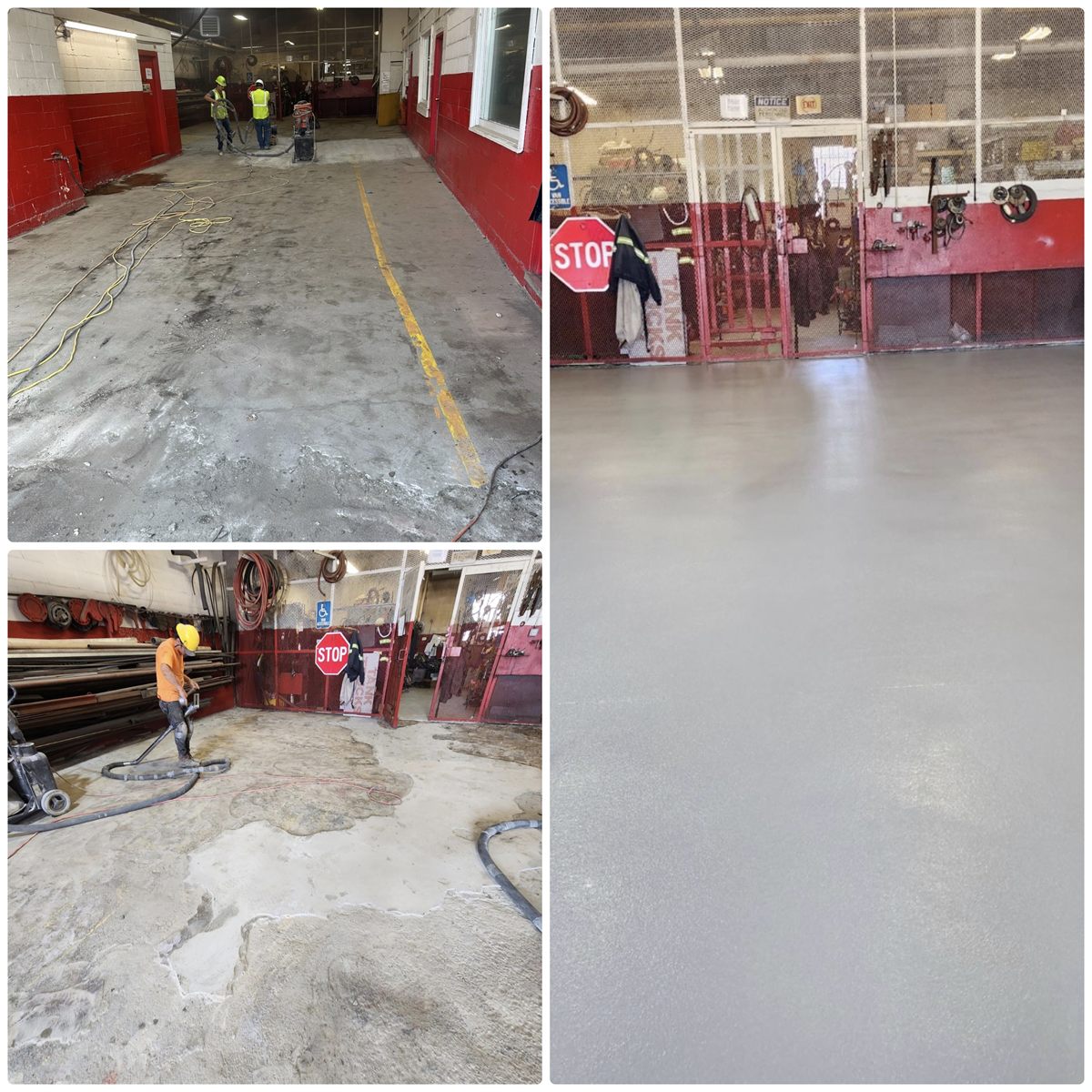
Maintenance shop floor — rebuilt and coated bay by bay around live equipment
Specify It Once, Correctly
The Architect Center carries the full standard detail library, isometric system shop drawings, and CSI 3-part specifications under Section 09 67 23 Resinous Flooring.
Straight Answers Before You Call
What floor goes in an aircraft hangar or MRO bay?
It starts with the fluids and the loads. Aviation hydraulic fluids, fuel, and lubricant drips call for a chemical-resistant epoxy body with a hard-wearing urethane topcoat; jack points and tug lanes call for quarter-inch MavClad EM troweled mortar that takes the point load without crushing. Resin selection follows the chemical-resistance chart on each product data sheet. Deicing fluid tracked in on the gear and wide-bay joints are handled in the detailing. No two hangars get the same build, because no two slabs or operations are the same.
Can you install ESD flooring in avionics or defense electronics areas?
Yes. Our static-dissipative floor is MavCoat ESD static-dissipative urethane floor coating applied over an epoxy insulator coat and grounded to the building - surface resistance, point to point/ground, 1×10^5 to <1×10^9 ohms per ANSI/ESD STM 7.1 - for electrical assembly, circuit-board handling, avionics areas, static-sensitive manufacturing and packaging, clean rooms, and labs. It is tested in place before handover.
Can the work be phased around flight operations or depot schedules?
That is how this work is engineered. We sequence by bay, machining cell, or depot lane so adjacent space stays in service, and we carry fast-cure options such as MavSeal UPA Fast Cure, MavCoat FC basecoat, and MavRapidPatch for the areas that have to be back under load the next shift. Bring us the shutdown window and we engineer the floor around it.
Why not publish one aerospace flooring system?
Because an aerospace or defense campus is not one application. The hangar, the composite shop, the machining cell, the vehicle depot, the electronics lab, and the parts store each see different chemistry, loads, and cleaning, and each has its own history with previous floors. Every Maverick system is engineered to the substrate, the abuse, and that history. Only new construction over bare concrete comes close to a standard build.
Planning This Work?
Flight schedules, depot throughput, occupied hangars — bring us the constraint and we will engineer the floor around it.