

Water & Wastewater Treatment Flooring Systems
Hypochlorite, ferric, caustic, and sulfuric on the feed side; grit, polymer, and constant washdown on the solids side; sumps and wet wells that never dry out. Maverick engineers the floors, secondary containment, and linings for municipal and industrial water treatment plants, wastewater and sewage treatment plants, lift and pumping stations, chemical dosing facilities, and sludge processing facilities — and the transfer stations, recycling and material recovery facilities, hazardous waste treatment, and leachate treatment plants that share their chemistry.
One Plant, Six Different Floors
A treatment plant is not one application. The chemical feed room sees concentrated oxidizer and acid; the filter gallery sees backwash spray all day; the dewatering bay sees grit, polymer, and pressure washers; the lab sees foot traffic and spilled reagent. Each room gets its own build, and the build changes with the condition of the slab under it.
The build for a chemical feed or dosing room is typically a ¼″ troweled epoxy mortar body with a novolac topcoat and monolithic coved berms — see chemical-resistant linings and secondary containment. Wet process floors move to urethane cement for washdown and thermal shock. Shops, labs, and control rooms step down to coatings sized to the traffic.
Chemical Feed & Dosing Rooms
Sodium hypochlorite, ferric chloride, caustic, and sulfuric acid service. Troweled mortar body, novolac topcoat, and monolithic coved berms around day tanks and metering pumps — the room built as secondary containment, with the drip zones under the pumps and the curb-to-floor joint detailed first, because that is where the last floor failed.
Pump & Blower Rooms
Vibration, lube oil, condensation, and seal-water puddles at the bases; wet wells and sumps below. Pump bases rebuilt and sloped to drain, sumps and trenches lined as one piece with the floor, then a high-build epoxy or troweled mortar sized to how often the pumps come out.
Filter Galleries & Process Floors
Wet all shift from backwash spray, sample taps, and chemical mist. Urethane cement or a quartz-broadcast urethane body with slip-resistant texture, sloped to the trench drains that already exist, with the trenches lined in the same pass.
Lab & Control Rooms
Reagent drips, rolling chairs, and a floor that has to look right for the operators and the inspectors. Self-leveling epoxy or a decorative broadcast with an integral cove base.
Sludge Dewatering & Solids Handling
Grit, polymer, centrate, and pressure washers around belt presses and centrifuges — the floor that eats epoxy. Thermal-shock-rated urethane cement, coved and sloped, with a chemical-resistant topcoat where polymer and ferric meet, and the equipment pads rebuilt where the old floor let water under them.
Maintenance Shops & Vehicle Bays
Oils, fuels, hot tires, dropped parts, and the vactor truck backing in wet. Impact-resistant epoxy or quartz broadcast with the control joints filled so the forklift stops chipping them.
| Zone | Primary Exposure | Typical Starting Point | Nominal Thickness |
|---|---|---|---|
| Chemical Feed & Dosing Rooms | Hypochlorite, ferric chloride, caustic, sulfuric acid; spills and drips at day tanks and pumps | MavClad EM epoxy mortar with MavCoat NV novolac topcoat; monolithic coved containment berms | ¼″ |
| Pump & Blower Rooms | Vibration, lube oil, condensation, seal water; equipment pulls; sumps and wet wells | MavCoat HB high-build epoxy; MavClad EM at pump bases and rigging paths; lined sumps and wet wells; bases rebuilt with the repair line | — |
| Filter Galleries & Process Floors | Constant wet, backwash spray, chemical mist, slip hazard | MavCrete UM urethane cement or MavTop UQ-HD quartz broadcast over a urethane body; lined trench drains | ¼″ |
| Lab & Control Rooms | Reagent spills, foot traffic, cleanability, appearance | MavCoat SLE self-leveling epoxy or MavTop decorative broadcast; integral cove base | — |
| Sludge Dewatering & Solids Handling | Grit abrasion, polymer, centrate, hot-water washdown, thermal shock | MavCrete UM urethane cement; MavCoat NV topcoat where chemistry demands it | ¼″ |
| Maintenance Shops & Vehicle Bays | Oils, fuels, impact, hot tires, truck traffic | MavCoat HB epoxy or MavTop UQ-HD quartz; MavJoint JF at control joints | — |
Starting points, not prescriptions. Every Maverick system is engineered to the condition of the substrate, the abuse it takes, and the facility’s history with previous floors — the build changes from room to room and plant to plant. Only new construction over bare concrete comes close to a standard build.
Containment, sumps, wet wells, and tank linings are part of the work. Chemical exposure is assessed per facility — which chemistry, at what temperature, for how long it sits — and the resin is matched to it from the chemical-resistance chart on each product data sheet. Deteriorated concrete is removed to sound substrate; curbs, berms, and pad edges with section loss are rebuilt before anything is coated; coves, curbs, sumps, trenches, and pipe penetrations are detailed monolithically so the lining has no seam to fail at. Secondary containment pads, lined sumps and trenches, lift-station wet wells, and chemical tank and process linings are Maverick work, not a referral.
Facilities We Serve
- Municipal water treatment plants
- Industrial water treatment plants
- Water filtration plants
- Water pumping stations
- Desalination facilities
- Municipal wastewater treatment plants
- Industrial wastewater treatment
- Lift stations
- Chemical dosing facilities
- Sludge processing facilities
- Hazardous waste treatment facilities
- Recycling facilities
- Material recovery facilities
- Landfill leachate treatment
The Systems This Work Demands
MavCoat NV & CRE Chemical-Resistant Epoxies
Novolac for concentrated acids and oxidizers; CRE where exposure is intermittent — the topcoats over the mortar body and the lining chemistry for sumps and containment.
Explore the SystemMavClad EM Epoxy Mortar
¼″ troweled, chemically resistant — the heavy-duty body under feed rooms, pump bases, and containment pads.
Explore the SystemMavCrete UM Urethane Cement
Thermal shock and washdown service — the body for dewatering bays and filter galleries.
Explore the SystemChemical-Resistant Work, Photographed On Site
A chemical tank area floor and its containment rebuilt around in-service tanks — concrete removed to sound substrate, section loss at the curbs and pad edges rebuilt, mortar body, monolithic coves, and chemical-resistant topcoat. Maverick batches its own products in its own plants and installs them with its own crews, so one company owns the chemistry, the installation, and the single-source warranty.
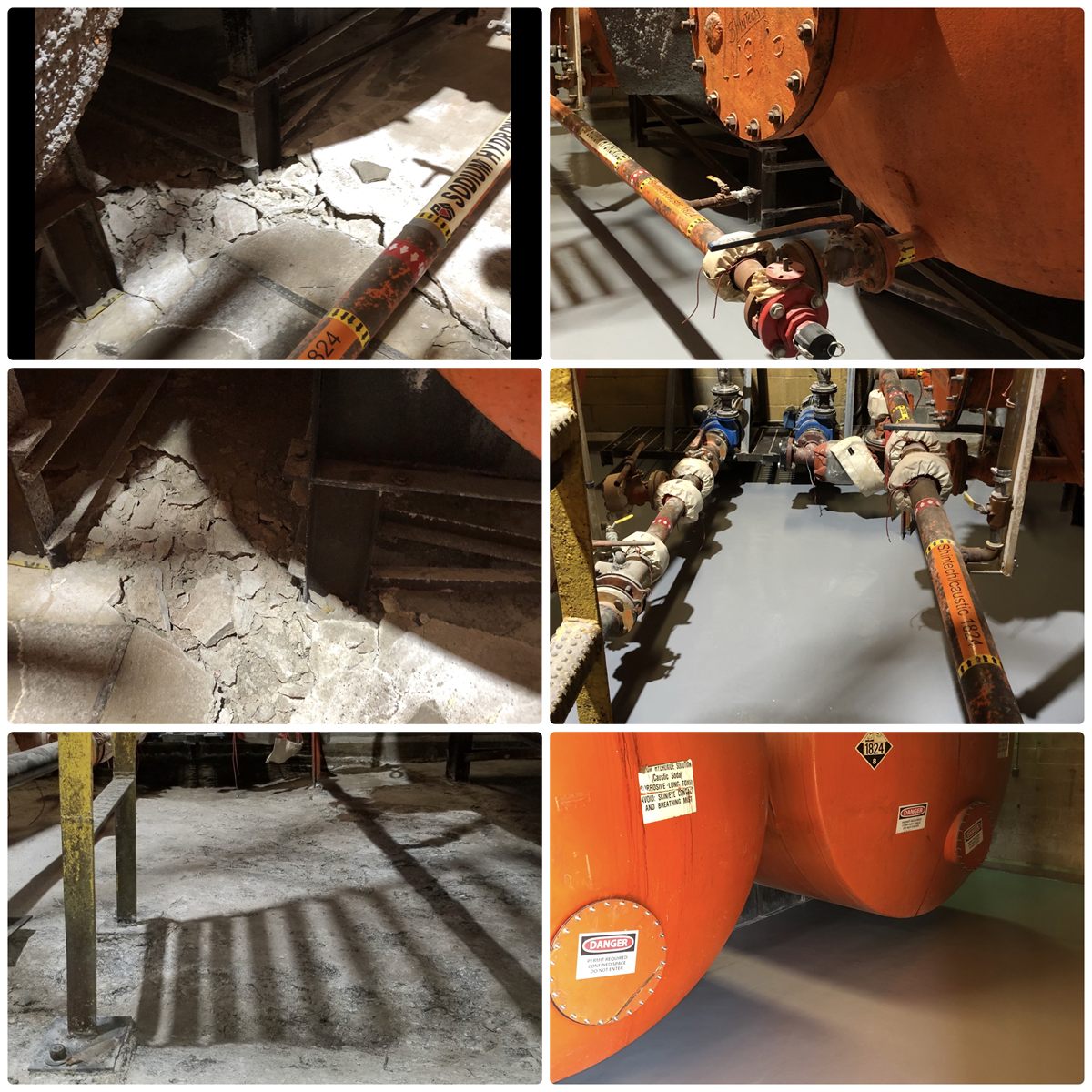
Chemical tank area — floor and containment rebuilt around in-service tanks
Specify It Once, Correctly
The Architect Center carries the full standard detail library, isometric system shop drawings, and CSI 3-part specifications under Section 09 67 23 Resinous Flooring.
Straight Answers Before You Call
Can Maverick line a wet well, sump, trench, or process tank?
Yes. Lift-station wet wells, pump-room sumps, trench drains, containment pads, and chemical tank and process linings are Maverick work. The exposure is assessed per facility, meaning which chemistry, at what temperature, and how long it sits, and the resin is matched to it from the chemical-resistance chart on each product data sheet. Deteriorated concrete comes out to sound substrate, section loss at the walls and benches is rebuilt, and the transitions from floor to wall to penetration are detailed as one monolithic lining, because a lining fails at its seams and corners before it fails in the field.
What floor goes in a sodium hypochlorite or ferric chloride feed room?
The starting point is a quarter-inch MavClad EM troweled epoxy mortar body with a MavCoat NV novolac topcoat, coved up the berm and around the day tank pads so the room works as secondary containment. Novolac epoxy is our chemistry for concentrated acids and oxidizers; MavCoat CRE covers rooms where exposure is intermittent. Name the chemistry on the drawings and we match the resin to it, because hypochlorite, ferric, caustic, and sulfuric do not all want the same floor. For a specific reagent, refer to the chemical-resistance chart on each product data sheet.
Can you install in an operating plant without taking the process down?
Yes. The work is phased room by room around live equipment and live chemical feed. Where a room cannot be out of service long, fast-cure options such as MavSeal UPA Fast Cure, MavCoat FC basecoat, and MavRapidPatch shorten the window, and our 100 percent solids, zero-VOC chemistries keep odor down in enclosed galleries. Tell us the shutdown window and we will engineer the sequence to it.
Why urethane cement in the dewatering and filter areas instead of epoxy?
Those floors are wet all shift and get hit with hot pressure washers, and standard epoxy mortar is not built for thermal shock. MavCrete UM cementitious urethane is thermal shock resistant through 250 degree Fahrenheit washdown and tolerates the constant moisture, so it is the body we start from in dewatering bays, filter galleries, and screening rooms. Where polymer and ferric meet on the same floor, a MavCoat NV topcoat goes over it for the chemistry.
Planning This Work?
Shutdown windows, phasing, occupied plants — bring us the constraint and we will engineer the floor around it.