

Chemical Processing & Petrochemical Flooring
Bulk and specialty chemical manufacturing, chlor-alkali processing, petroleum refining, natural gas processing, LNG facilities, storage terminals, and tank farm operators. One plant, six exposure zones, no single floor that fits them all. Maverick engineers the process floor, the secondary containment, the trench, and the pump pad to the chemistry each one actually sees — and installs every one of them with its own crews.
Six Zones, Six Exposure Schedules
Chemical exposure is not one condition. Concentration, temperature, dwell time, and the mechanical abuse layered on top decide the resin, the body, and the detailing — and those change from the containment dike to the drum warehouse inside the same fence line.
Process floors take spills, washdown, and forklifts between turnarounds. Containment holds concentrated chemistry until it is pumped out. Tank farms sit outdoors through freeze-thaw and UV. Trenches and sumps fail at the corners and terminations. Pump pads leak at the seal. Warehouses take impact and the occasional ruptured tote. The dedicated chemical-resistant linings & secondary containment service page covers the containment and lining scope in depth; this page maps the whole plant.
Facilities We Serve
- Bulk chemical manufacturing
- Specialty chemical manufacturing
- Chlor-alkali processing
- Paint and coating manufacturing
- Resin and polymer manufacturing
- Fertilizer and agricultural chemical manufacturing
- Petroleum refining
- Natural gas processing
- LNG facilities
- Petroleum storage terminals
- Tank farm operators
- Drum and tote handling facilities
- Metal pickling
- Battery electrolyte processing
Secondary Containment
Dikes, curbs, and berms around acid storage, caustic chemical storage, and bulk chemical transfer. Troweled mortar bodies with integral cove and a topcoat matched to the stored chemistry — engineered to the spill rule and inspection regime the facility operates under.
Process Floors
Blending, mixing, reaction, and packaging areas in bulk and specialty chemical plants. ¼″ troweled mortar bodies that take spills, washdown, and mechanical abuse between turnarounds, finished with the chemical-resistant topcoat the process calls for.
Tank Farms & Loading
Exterior tank farms, petroleum storage terminals, fuel blending, and chemical loading and unloading terminals. Exterior-rated builds over rebuilt, sloped substrate that tolerate thermal cycling, UV, and the trucks and forklifts that service the tanks.
Trenches, Sumps & Pits
Industrial sumps and trenches, process pits, and collection pits where chemistry stands before it drains. Lined and detailed to drain, with the corners and terminations — where containment actually fails — detailed first.
Pump Pads & Equipment Bases
Pads under transfer pumps, pipeline pump stations, and process equipment. Rebuilt, sloped to shed seal drips toward containment, and coated — including positive-side waterproofing where a pad sits over occupied or sensitive space.
Warehouses & Drum/Tote Handling
Chemical storage and distribution, drum and tote handling, and solvent storage. Impact- and abrasion-resistant floors that shrug off a dropped drum and hold an incidental leak long enough to clean it up.
| Zone | Primary Exposure | Typical Starting Point | Nominal Thickness |
|---|---|---|---|
| Secondary Containment | Stored chemistry at concentration; spill dwell time; inspection regime | MavClad EM troweled mortar with integral cove; MavCoat NV novolac topcoat where concentrated acids are stored, MavCoat CRE for general chemistry — see linings & containment | ¼″ |
| Process Floors | Spills, washdown, forklift and mechanical abuse between turnarounds | MavClad EM epoxy mortar; MavCrete UM urethane cement where thermal shock or organic acids govern; MavCoat CRE or NV topcoat matched to the exposure | ¼″ |
| Tank Farms & Loading | Exterior thermal cycling, UV, truck and forklift traffic, transfer spills | Exterior-rated build over substrate rebuilt and sloped with the repair line; chemical-resistant body where transfer spills land; UV-stable MavSeal topcoat | — |
| Trenches, Sumps & Pits | Standing chemistry; drainage; corner and termination detailing | Troweled mortar lining with coved, monolithic transitions at corners and penetrations; MavGrout USP slope-to-drain; topcoat read from the data-sheet chart for the standing chemistry | — |
| Pump Pads & Equipment Bases | Seal leaks, vibration; pads over occupied or sensitive space | Rebuilt and sloped with the repair line, then coated to shed drips to containment; positive-side waterproofing where required | — |
| Warehouses & Drum/Tote Handling | Impact, abrasion, incidental drum and tote leaks | MavCoat HB or PC over MavPrime EP; MavCoat CRE topcoat where leaks are routine; MavClad EM in heavy-abuse aisles | — |
Starting points, not prescriptions. Every Maverick system is engineered to the condition of the substrate, the abuse it takes, and the facility’s history with previous floors — the build changes from room to room and plant to plant. Only new construction over bare concrete comes close to a standard build.
Exposure assessed per facility. Chemistry, concentration, temperature, and dwell time in each zone are read against the chemical-resistance chart on each product’s data sheet — MavClad EM, MavCoat NV, MavCoat CRE, MavCrete UM — before a system is named. Refineries, gas processing and fractionation plants, LNG facilities, pipeline terminals, and offshore facilities get the same treatment: containment, trenches, sumps, pump pads, loading areas, process floors, and process tank linings, each engineered to the chemistry it sees. The containment and lining scope in depth is on the chemical-resistant linings & secondary containment page.
The Systems This Work Demands
MavClad builds the body on most chemical floors. The topcoat chemistry — novolac, chemical-resistant epoxy, or urethane cement — is selected against the exposure. The substrate is rebuilt first. For the containment and lining scope itself, start at chemical-resistant linings & secondary containment.
MavClad EM Epoxy Mortar
¼″ trowel-applied 100% solids epoxy mortar with integral cove — the seamless, chemical-resistant body for process floors and containment.
Explore the SystemMavCoat NV & CRE Chemical-Resistant Coatings
MavCoat NV novolac epoxy for concentrated-acid service; MavCoat CRE chemical-resistant epoxy for dilute acids, caustics, and general plant chemistry.
Explore the SystemRepair & Slope Restoration
MavPatch, MavRapidPatch, MavPolyPatch, and MavGrout USP — acid-etched, spalled, and off-slope concrete rebuilt before the system goes down.
Explore the SystemContainment Rebuild, Start to Finish
A secondary containment pad at a chemical processing facility: severe section loss and exposed rebar at the curbs and pad edges, concrete removed to sound material, section rebuilt, and the pad, curbs, and sumps lined as one monolithic system. Maverick formulates and batches the products in its own plants, installs with its own crews, and stands behind the whole stack under a single-source warranty with a 48-hour response.
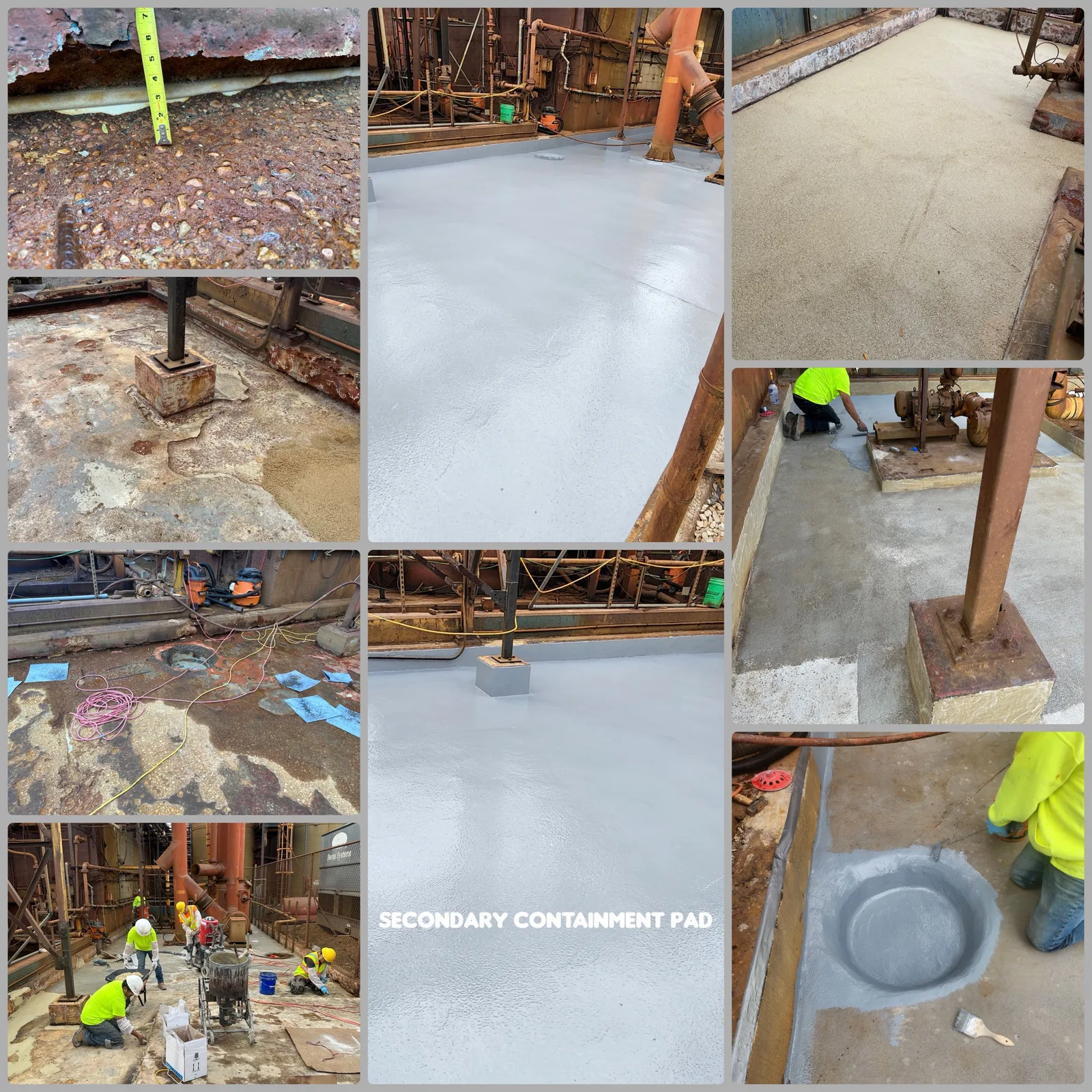
Secondary containment pad — before and after
Specify It Once, Correctly
The Architect Center carries the full standard detail library, isometric system shop drawings, and CSI 3-part specifications under Section 09 67 23 Resinous Flooring. Containment cove, trench, and slope-to-drain details are drawn for the chemistry, not copied from a generic floor.
Straight Answers Before You Call
Does a chemical plant need the same floor in every area?
No. A containment dike holding concentrated acid, a process floor taking forklift traffic and washdown, an exterior tank farm cycling through Michigan winters, and a drum warehouse with incidental leaks are four different exposure schedules, and they get four different builds. The body of the floor, the topcoat chemistry, the slope, the cove, and the joint treatment each change by zone. The zone table on this page lists starting points; the build for your plant is engineered from the substrate condition, the chemistry actually stored or processed there, and the facility’s history with previous floors.
What floor handles concentrated acid spills?
For concentrated mineral acids the starting point is a MavClad EM troweled epoxy mortar body finished with MavCoat NV, our 100% solids zero-VOC novolac epoxy, whose data sheet lists resistance to concentrated acids including 98% sulfuric acid and UAN. For dilute acids, caustics, and general plant chemistry MavCoat CRE, a chemical-resistant epoxy with superior resistance over standard epoxies, is usually sufficient. Where organic acids or hot washdown are in play, the body changes to MavCrete UM urethane cement. In every case the facility’s chemistry, concentration, temperature, and dwell time are read against the chemical-resistance chart on each product’s data sheet before the system is specified.
Do you line containment, trenches, and sumps at refineries and chemical plants?
Yes. Secondary containment dikes and curbs, trenches, sumps and pits, pump pads and pedestals, loading and unloading areas, and the process floors between them are all Maverick scope at refineries, gas processing and fractionation plants, LNG facilities, terminals, and chemical plants. The containment structure is rebuilt to sound concrete first — severe section loss and exposed rebar at curbs and pad edges are the common failure — then the cove, curb face, sump, and every penetration are detailed as one monolithic lining. Chemical exposure is assessed per facility against the chemical-resistance chart on each product’s data sheet. Process tank and vessel linings are covered on the chemical-resistant linings and secondary containment page.
Can this work be done while the plant is running?
Usually yes, zone by zone. Most chemical and petrochemical floor work is phased around live process equipment, isolated by containment area or bay, and scheduled into turnaround and outage windows. Where a fast return matters, fast-cure options exist across the line: MavCoat FC basecoat, MavRapidPatch and MavPolyPatch for repairs, and MavSeal UPA Fast Cure as a topcoat. Because Maverick formulates the products and installs them with its own crews, the sequence, cure schedule, and site safety plan come from one company under a single-source warranty.
Real Maverick Work
Maverick crews installing Maverick-manufactured systems. Captions describe what is visible in each frame.
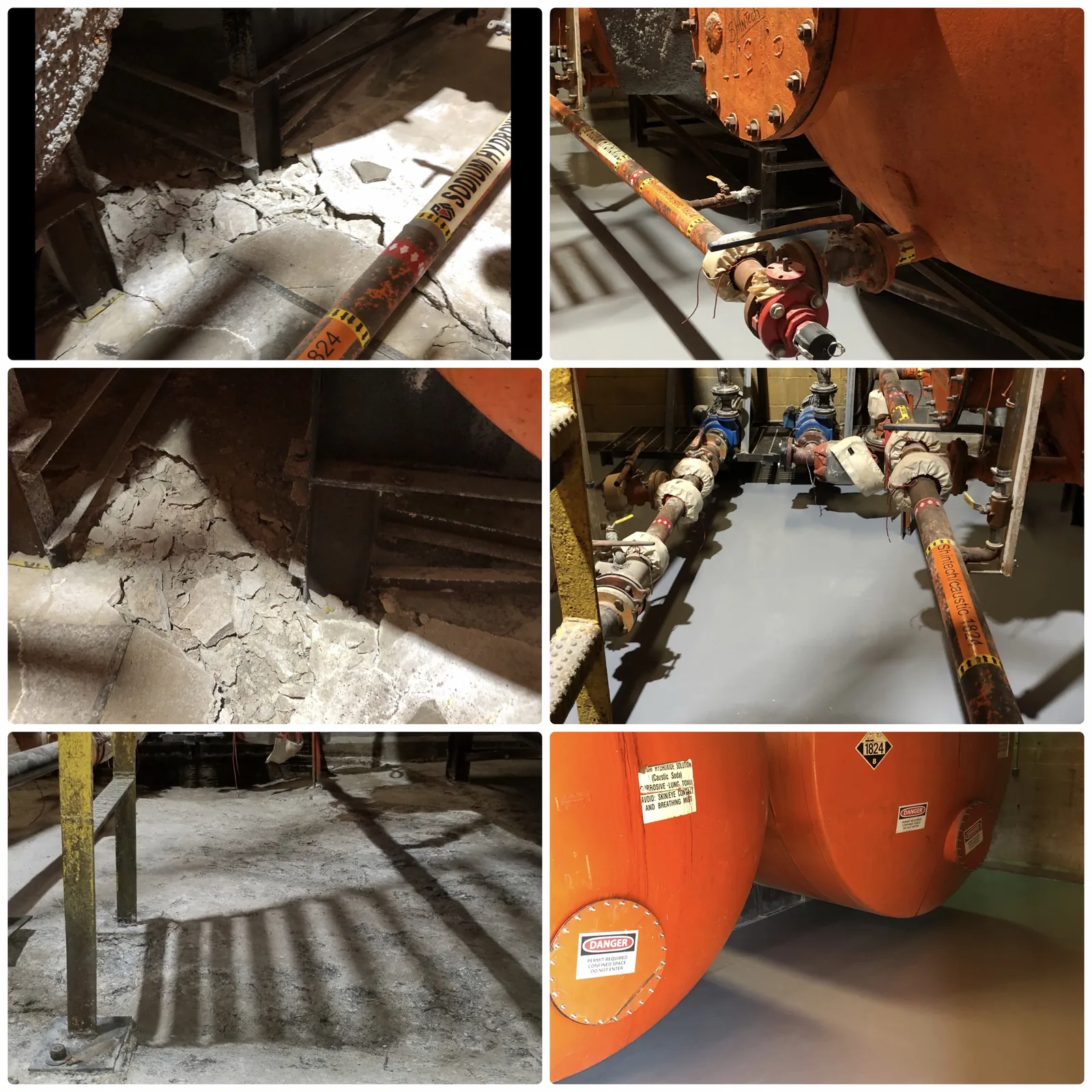
Caustic tank room: crumbling concrete under tanks and piping rebuilt and coated as a containment floor
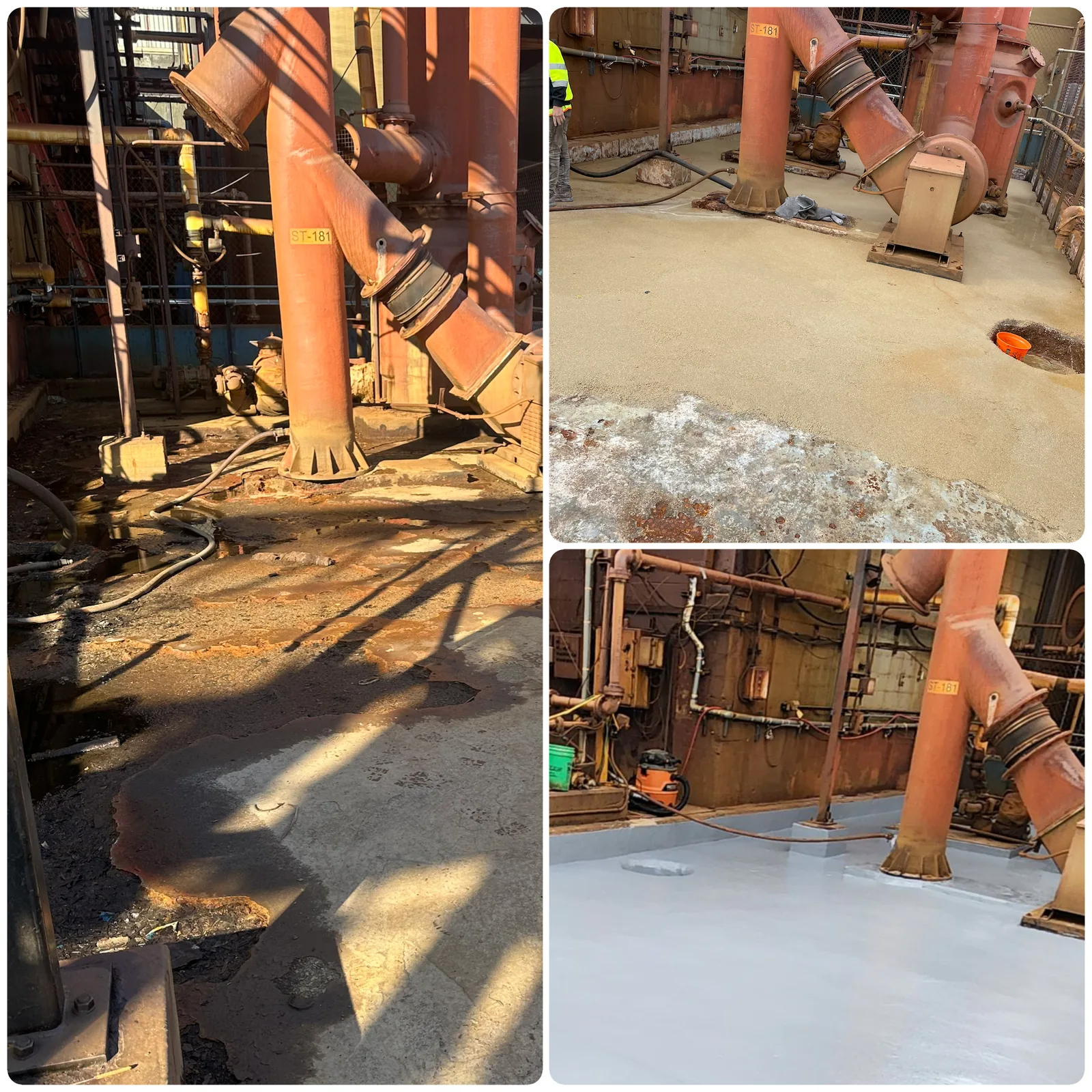
Containment pad around process equipment: deteriorated concrete rebuilt and coated, before and after
Planning This Work?
Turnaround windows, live process equipment, exposure schedules that change by the bay — bring us the constraint and the chemistry and we will engineer the floor around both.