

Commercial Kitchen Flooring — Out With the Quarry Tile, Overnight
Commercial kitchen flooring is a seamless, non-porous floor system — most often urethane cement (cementitious urethane) — installed over the concrete slab in cook lines, dish pits, prep areas, and walk-ins. Unlike quarry tile, it has no grout lines to trap water and bacteria, it is rated for thermal shock from hot-oil and washdown cycles, and it is finished with an integral cove base and slope-to-drain so the whole floor cleans as one surface.
Quarry Tile Fails the Same Way in Every Kitchen
Quarry tile was never the problem — the grout was. Every grout line is a porous joint that traps washdown water, grease, and bacteria millimeters from food prep. The setting bed underneath soaks it all up. Then the fryer line delivers years of thermal cycling — hot oil splash, then a cold hose — and tiles crack, pop, and rock underfoot while the grout powders out around them. A standard kitchen epoxy floor fares no better at the fryer line — epoxy is too rigid for that thermal cycling, which is why the replacement is urethane cement, not epoxy.
By the time a facility calls us, the pattern is familiar: loose tiles at the cook line, standing water at a drain that no longer sits low, a sour smell that survives every deep clean, and an inspector writing up the same floor findings every visit. Patching individual tiles treats the symptom. The fix is to remove the failed tile and setting bed and replace them with one monolithic floor.
What Replaces It
Maverick replaces failing quarry tile with MavCrete cementitious urethane — a troweled urethane cement mortar placed at 1/4 inch or more, rated for thermal shock through 250°F washdown at 1/4″ thickness. It withstands steam cleaning, resists the lactic, citric, and acetic acids of food service, and installs with an integral cove base so wall-to-floor transitions clean as one surface.
- Seamless and non-porous — no grout lines, nowhere for water or bacteria to harbor.
- Thermal shock rated through 250°F washdown at 1/4″ system thickness.
- Integral cove base troweled up every wall and curb — not glued-on trim.
- Slope-to-drain rebuilt in the floor body, not disguised with coating.
- Slip texture engineered per zone — wet DCOF > 0.63 (ANSI A326.3, broadcast finish).
Kitchens Can't Close. So We Don't Ask Them To.
The work is phased zone by zone through your service windows: the kitchen closes at night, one contained zone gets demolished, prepped, or placed, and the rest of the kitchen serves the next day. Larger areas use holiday closures and seasonal shutdowns. Here is what a typical overnight window looks like on a quarry-tile replacement.
| Time | What Happens |
|---|---|
| 10:00 PM | Kitchen closes. Line equipment wrapped and protected; work zone contained from the rest of the kitchen. |
| 10:30 PM | Night 1 scope: quarry tile and setting bed demolished, substrate exposed and evaluated. Night 2 scope: diamond grinding, key cuts at terminations, cove prep. |
| 1:00 AM | Slope corrections — MavGrout USP urethane slope grout rebuilds pitch-to-drain from 1/2″ up to 3″ where drains sit high. |
| 3:00 AM | MavCrete UM mortar placed, integral cove base troweled up walls and curbs, quartz or flake broadcast seeded to rejection. |
| 5:30 AM | Cleanup and containment reset. The placed zone stays barricaded while it cures; the rest of the kitchen opens on time. |
| Final night | Pigmented topcoat and MavJoint JF joint filler. Foot traffic returns 8–12 hours after the final coat. |
Where a same-morning handback is non-negotiable, we specify a fast-cure system — the MavSeal UPA polyaspartic topcoat returns foot traffic in 4–6 hours.
From Failed Tile to Finished Floor
Every kitchen floor we install follows the same engineered sequence — and every layer is a Maverick-manufactured product with a published technical data sheet. Full system documentation lives on the MavCrete cementitious urethane system page.
| Step | Scope | System Component |
|---|---|---|
| 1. Demolition | Quarry tile and setting bed removed; substrate sounded and mapped. Well-bonded tile may be ground and capped instead where testing supports it. | — |
| 2. Preparation | Diamond grinding to profile, key cuts at terminations and doorways, moisture evaluation. MavCrete installs over high-moisture and green concrete where epoxies require costly mitigation. | Urethane primer per system spec |
| 3. Slope & drains | Pitch-to-drain rebuilt in the floor body; trench and round drain transitions per the MAV-CU standard detail series. | MavGrout USP, 1/2″–3″ |
| 4. Mortar body | Troweled urethane cement placed at 1/4″ or more, filling integral coves and key chases in the same placement. | MavCrete UM |
| 5. Texture by zone | Quartz broadcast to rejection at wet zones; flake or smoother broadcast where carts roll and cleaning speed matters. | MavTop UQ-HD / UF-HD |
| 6. Topcoat & joints | Pigmented topcoat locks the broadcast; moving joints honored and sealed with washdown-rated semi-rigid filler in six standard colors. | Pigmented MavCoat / MavSeal topcoat + MavJoint JF |
One Kitchen, Four Duty Ratings
A dish pit and a servery should not get the same floor. Texture is tuned to each zone's duty — aggressive where the floor stays wet, smoother where carts roll — while the broadcast finish holds a wet DCOF greater than 0.63 per ANSI A326.3 system-wide.
Cook Line & Fry Stations
Hot fryer oil, then a cold hose — the thermal-shock zone. MavCrete UM at 1/4″ absorbs the cycling that delaminates thin coatings and cracks tile, rated through 250°F washdown.
Dish Pits & Pot Wash
Scalding water and detergent around the clock. MavTop UQ-HD's angular quartz texture keeps crews on their feet on a permanently wet floor.
Walk-In Coolers & Freezers
Defrost cycles and door-line condensation. Urethane cement's thermal expansion is close to concrete's, so it tracks the slab through every temperature swing.
Prep, Servery & Back Dock
Cleanable, slip-balanced texture where staff pivot all shift — and heavier duty at the back dock, where grease bins and cart traffic kill floors first.
See how these zones come together across a full facility on the commercial kitchens industry page.
Built for the Health Inspection, Not Just the Rush
Floor findings are the easiest write-ups an inspector makes: cracked grout, standing water, exposed setting bed, a cove pulling off the wall. A MavCrete kitchen floor is detailed to remove those findings at the source — seamless, non-porous surfaces that support your sanitation plan, with an integral cove base and positive slope to drain built into the floor itself. The same system family is engineered to support USDA/FSIS sanitation requirements in inspected food facilities, and moving joints are sealed with washdown-rated MavJoint JF.
- No grout lines — one monolithic surface from drain to cove, nowhere for bacteria to harbor.
- Integral cove base up every wall and curb, troweled from the same mortar — the wall-to-floor joint disappears.
- Positive slope to drain rebuilt in the floor body, so washdown water leaves instead of standing.
- Sealed joints — moving joints honored and filled with washdown-rated MavJoint JF.
The Numbers Behind the Floor
| Property | Test Method | Typical Value |
|---|---|---|
| Compressive strength | ASTM C579 | 7,800 psi |
| Bond strength to concrete | ASTM D4541 | 100% concrete failure |
| Impact resistance | ASTM D4226 | > 160 in·lb |
| Thermal shock service | — | Through 250°F washdown at 1/4 in. |
| Coefficient of friction, wet DCOF (broadcast finish) | ANSI A326.3 | > 0.63 |
| Return to service, foot traffic | — | 8–12 hours |
Over Failed Tile, Before and After
Photographed by our crew on the way in and on the way out.
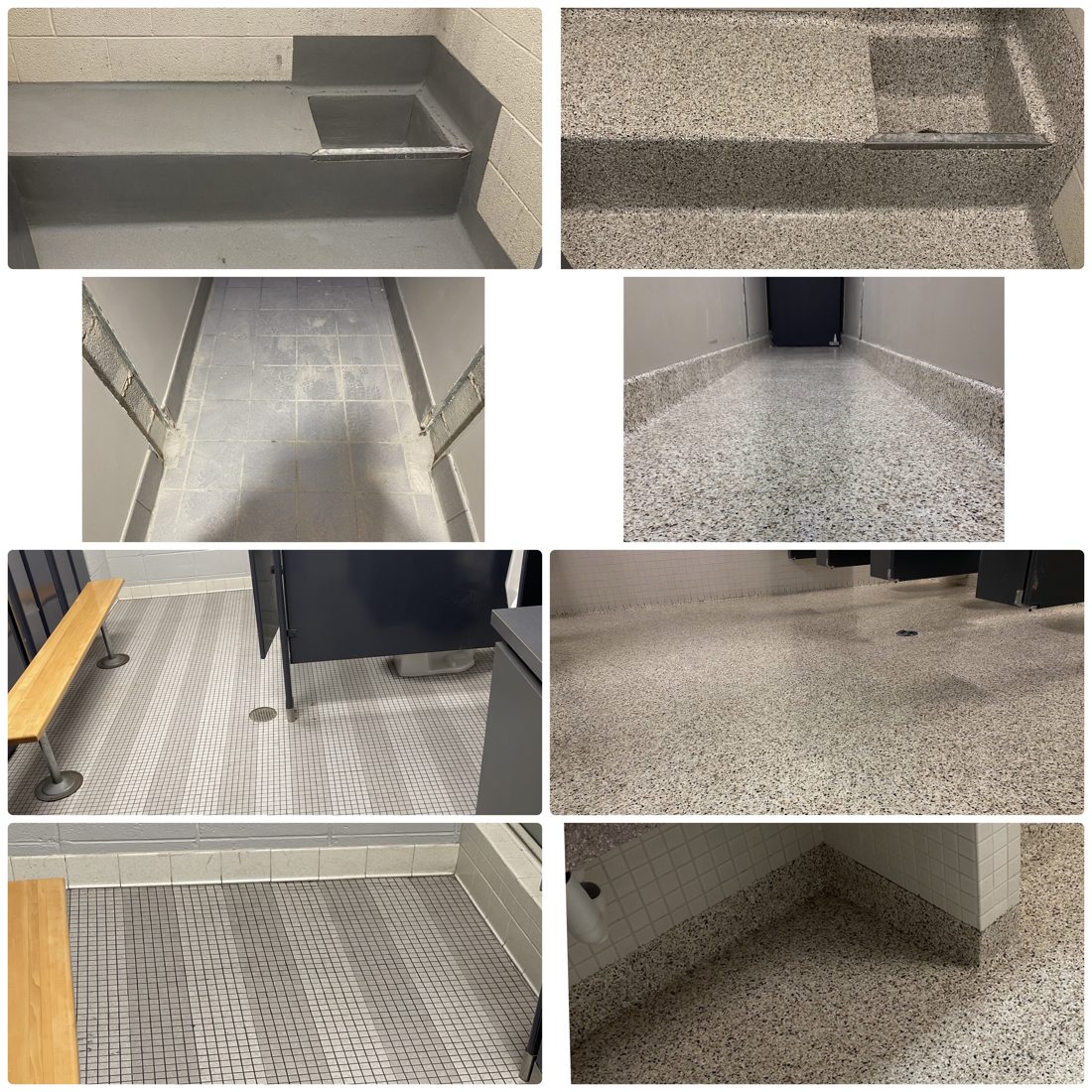
Seamless broadcast system installed directly over existing tile — washrooms, halls, and wet areas
Commercial Kitchen Flooring Questions, Answered
Can you install a new kitchen floor without closing the kitchen?
Yes. We phase the work zone by zone through overnight windows — the kitchen closes at night, one contained zone is demolished, prepped, or placed, and the rest of the kitchen serves the next day. MavCrete urethane cement returns to foot traffic in 8–12 hours, and for the tightest windows a fast-cure topcoat system can return foot traffic in 4–6 hours. Holiday closures and seasonal shutdowns are used the same way for larger areas.
Is a seamless kitchen floor slip resistant when it is wet?
Yes — the broadcast-finish MavCrete system carries a wet DCOF greater than 0.63 per ANSI A326.3. Texture is engineered per zone: aggressive quartz at the cook line and dish pit where the floor stays wet, and a smoother broadcast at prep and servery areas where carts roll and cleaning speed matters.
How do you handle floor drains and slope?
Slope is rebuilt in the floor body, not faked with a thin coating. MavGrout USP urethane slope grout rebuilds pitch-to-drain from 1/2″ up to 3″ beneath the system, and the mortar is finished into trench and round drain transitions using our standard MAV-CU detail series from the Architect Center. Every installation includes an integral cove base, so washdown water has one path: the drain.
Can the new floor go over existing quarry tile?
Sometimes. Sound, well-bonded tile can be ground and capped with a seamless broadcast system — we have rebuilt washrooms, halls, and wet areas directly over existing tile. But hollow, cracked, or delaminating tile comes out, setting bed and all, because a new floor is only as good as what it is bonded to. We sound-test during the site assessment and give you the answer per area.
How soon can the kitchen be back in service?
MavCrete urethane cement accepts foot traffic in 8–12 hours at 75°F, which is why a zone placed overnight is typically walkable for the next service day. Where a same-morning handback is required, a fast-cure build with the MavSeal UPA polyaspartic topcoat returns foot traffic in 4–6 hours.
What drives the cost of a commercial kitchen floor?
Square footage, how much tile and setting bed must come out, the extent of slope corrections, linear footage of cove base, the number of drains and equipment penetrations, the texture spec per zone, and how compressed the shutdown windows are. Overnight phasing costs more per square foot than a clear-building install but avoids lost service days. We return an engineered scope and budget within 48 hours of a site assessment.
Send Us Your Closing Time. We'll Engineer the Rest.
Tell us your hours, your zones, and what the tile is doing. We'll return a phased installation plan and budget range within 48 hours — our standing response promise.