

Chemical-Resistant Linings & Secondary Containment
A chemical-resistant lining keeps acids, caustics, and solvents off the concrete under it. Secondary containment is that lining built to hold a release — the dike, curb, sump, or pit that keeps stored chemistry in one place until it is pumped out. Maverick formulates the mortar, the novolac, and the chemical-resistant epoxy in its own plants, engineers the lining to the chemistry each structure actually sees, and installs it with its own crews: containment pads and curbs, trenches and sumps, pump pads and pedestals, process floors, and process tank and immersion linings. One company on the hook, from the rebuilt curb to the last cove termination.
Concrete Does Not Survive Chemistry On Its Own
Acids dissolve the cement paste and leave the aggregate standing proud. Caustics attack the paste more slowly and lift any coating that was not formulated for them. Solvents find the pinholes and pores in a standard epoxy and swell it from underneath. None of this is dramatic on day one — it is a pad that etches, dusts, pits, and loses the slope it was poured with, so a release that should have reached the sump stands where it landed. At the curbs and pad edges, chemistry and freeze-thaw work together until the concrete shows severe section loss and exposed rebar.
Then there are the spill rules. Facilities storing or processing regulated chemistry are expected to hold a release inside a containment area until it is cleaned up, and to keep the structure holding it sound and inspectable. A cracked dike, an uncoated cove, a sump with a bare corner, or a trench that no longer drains is a containment that does not contain. The lining is what makes the structure do its job — which is why it is engineered to the chemistry, not to the traffic.
What Decides the Lining
- Chemistry and concentration — a dilute caustic washdown and a concentrated sulfuric acid release are different products, not different thicknesses of the same one.
- Temperature — hot process streams and hot washdown move the body from epoxy mortar to urethane cement.
- Dwell time — incidental contact that is cleaned up within the shift, a release that sits in a dike for days, or a tank that holds chemistry continuously.
- Mechanical abuse on top — forklifts, drum dollies, dropped totes, and steel-wheeled carts riding over the same lining.
- Substrate condition — acid-etched, off-slope, section-lost, previously coated concrete is rebuilt before any lining goes down.
The Structures That Hold the Chemistry
Containment and lining work is a scope, not a single room. It shows up in the same shapes across very different plants, and every one of them is engineered to the chemistry it sees rather than to a standard detail.
Containment Dikes & Curbs
Bermed areas around bulk storage, day tanks, and tote stations. Lined pad, integral cove, and the curb face coated as one seamless unit so a release has no seam to find.
Trenches, Sumps & Pits
Where chemistry collects and stands before it is pumped out. The corners and terminations are detailed first, because that is where containment fails.
Pump Pads, Pedestals & Equipment Bases
Rebuilt and sloped to shed seal drips toward containment, then lined — with positive-side waterproofing where the pad sits over occupied or sensitive space.
Loading, Unloading & Drum Storage
Tanker, railcar, and tote transfer points where a hose-disconnect spill is routine, and drum and tote storage floors that take impact and still hold an incidental leak long enough to clean it up.
Chemical Dosing Rooms
Acid, caustic, hypochlorite, and polymer feed rooms at water and wastewater plants, utilities, and process facilities — small rooms with aggressive chemistry and a floor drain that has to work.
Process Tanks & Immersion Linings
Tanks, basins, and vessels that hold chemistry rather than catch it. Lined to the vessel — chemistry, concentration, temperature, and duty cycle — with the lining chemistry chosen against its data-sheet chart and the floor-to-wall transitions detailed monolithically.
The scope cuts across chemical processing and petrochemical plants, battery electrolyte processing, utilities, water and wastewater treatment, metal pickling and electroplating, galvanizing, chemical etching, semiconductor wet processing, and the containment and process areas of nuclear, offshore, and marine facilities. For a zone-by-zone map of a whole chemical plant, see the chemical processing & petrochemical flooring page; for the broader facility picture, the chemical facility guide.
- Chemical Processing
- Petrochemical & Refining
- Battery Electrolyte Processing
- Utilities
- Water & Wastewater
- Metal Pickling & Plating
- Galvanizing
- Semiconductor Wet Processing
- Chemical Waste Treatment
- Nuclear, Offshore & Marine
From Failed Concrete to a Monolithic Lining
A containment lining is only as good as the structure under it and the details at its edges. The sequence below is how Maverick builds every one — and because we formulate every layer, the move from one chemistry to the next is engineered, not improvised.
- Read the failure. Acid attack shows as exposed aggregate, pitting, and a pad that no longer falls to the sump. Caustic attack shows as softened paste and coatings lifting in sheets. Solvent attack shows as a coating swollen and blistered from underneath. At curbs and pad edges, chemistry and freeze-thaw together produce severe section loss and exposed rebar. At sumps, the failure is in the corners and at the terminations. Each one tells us what the substrate needs before it tells us what the lining needs.
- Prepare to sound concrete. Failed coatings and all unsound concrete come off. Concrete contaminated with chemicals is neutralized or removed, not coated over. The surface is mechanically prepared to a CSP 3–5 profile per ICRI Guideline 310.2R, and surface tensile strength and moisture are verified against the product data sheet before anything is primed. The full method is in our CSP surface prep guide.
- Rebuild the section loss. Exposed rebar is cleaned and the lost section of curbs, pad edges, and sump walls is rebuilt before the lining is considered. MavGrout USP urethane sloping and patching grout re-establishes fall to the sump or trench; MavPatch Epoxy repairs cracks and spalls; MavRapidPatch and MavPolyPatch take over when the shutdown window is short. See concrete floor repair for the full repair line.
- Detail the edges monolithically. MavCoat OPE orange-peel epoxy primes the vertical, so the lining turns up the curb face and the sump wall as one system with a 4–6 in. integral cove. Pipe sleeves, anchor bolts, drain bodies, and every other penetration are detailed into the lining rather than around it. Construction and control joints are filled with MavJoint JF semi-rigid joint filler so the lining is not undermined at the one place the slab was designed to move.
- Build the body. MavClad EM — ¼″ trowel-applied 100% solids epoxy mortar — is the seamless, chemical-resistant body for pads, process floors, and containment that take traffic and abuse. MavCrete UM cementitious urethane mortar takes over where hot process streams, hot washdown, or organic acids govern; it is thermal shock resistant through 250°F washdown.
- Select the topcoat against the chart. MavCoat NV is a 100% solids, zero-VOC novolac epoxy for aggressive chemical environments; its data sheet lists resistance to concentrated acids including 98% sulfuric acid and urea ammonium nitrate (UAN), with improved thermal shock resistance, and it is the chemical-resistant topcoat over MavCrete UM. MavCoat CRE is the chemical-resistant epoxy for dilute acids, caustics, salts, and mixed incidental exposure, with superior chemical resistance over standard epoxies. Where chemistry is incidental only — drum storage, light dosing — a MavCoat HB or PC build over MavPrime EP with a CRE topcoat is the starting point.
- Assess the exposure per facility. The chemistry, concentration, temperature, and dwell time in each structure are read against the chemical-resistance chart on each product’s data sheet — MavClad EM, MavCoat NV, MavCoat CRE, MavCrete UM — and the lining is named from that reading, not from a room type. The full sheet library is on the product data sheet library.
Starting Points by Exposure
- Concentrated mineral acids (sulfuric, UAN). MavClad EM body, MavCoat NV novolac topcoat, MavCoat OPE vertical primer under the cove.
- Dilute acids, caustics, salts, general plant chemistry. MavClad EM body, MavCoat CRE topcoat.
- Hot washdown, thermal shock, organic acids. MavCrete UM body; MavCoat NV topcoat where the chemistry demands it.
- Solvents, fuels, lubricants. MavClad EM body; CRE or NV topcoat read from the data-sheet chart for the solvent class and dwell time.
- Long or changing chemistry lists (waste treatment, dosing rooms). MavClad EM with MavCoat NV is the conservative default; the novolac covers the widest range.
- Incidental spills only (drum storage, light dosing). MavCoat HB or PC over MavPrime EP with a MavCoat CRE topcoat.
Starting points, not prescriptions. Every Maverick system is engineered to the condition of the substrate, the abuse it takes, and the facility’s history with previous floors — the build changes from room to room and plant to plant. Only new construction over bare concrete comes close to a standard build.
Containment Rebuild, Start to Finish
A secondary containment pad at a chemical processing facility: severe section loss and exposed rebar at the curbs and pad edges, concrete removed to sound material, section rebuilt, sumps and pump bases prepared and detailed, and the pad, curbs, and sumps lined as one monolithic system. Prep, rebuild, detail, line — the same sequence behind every structure on this page.
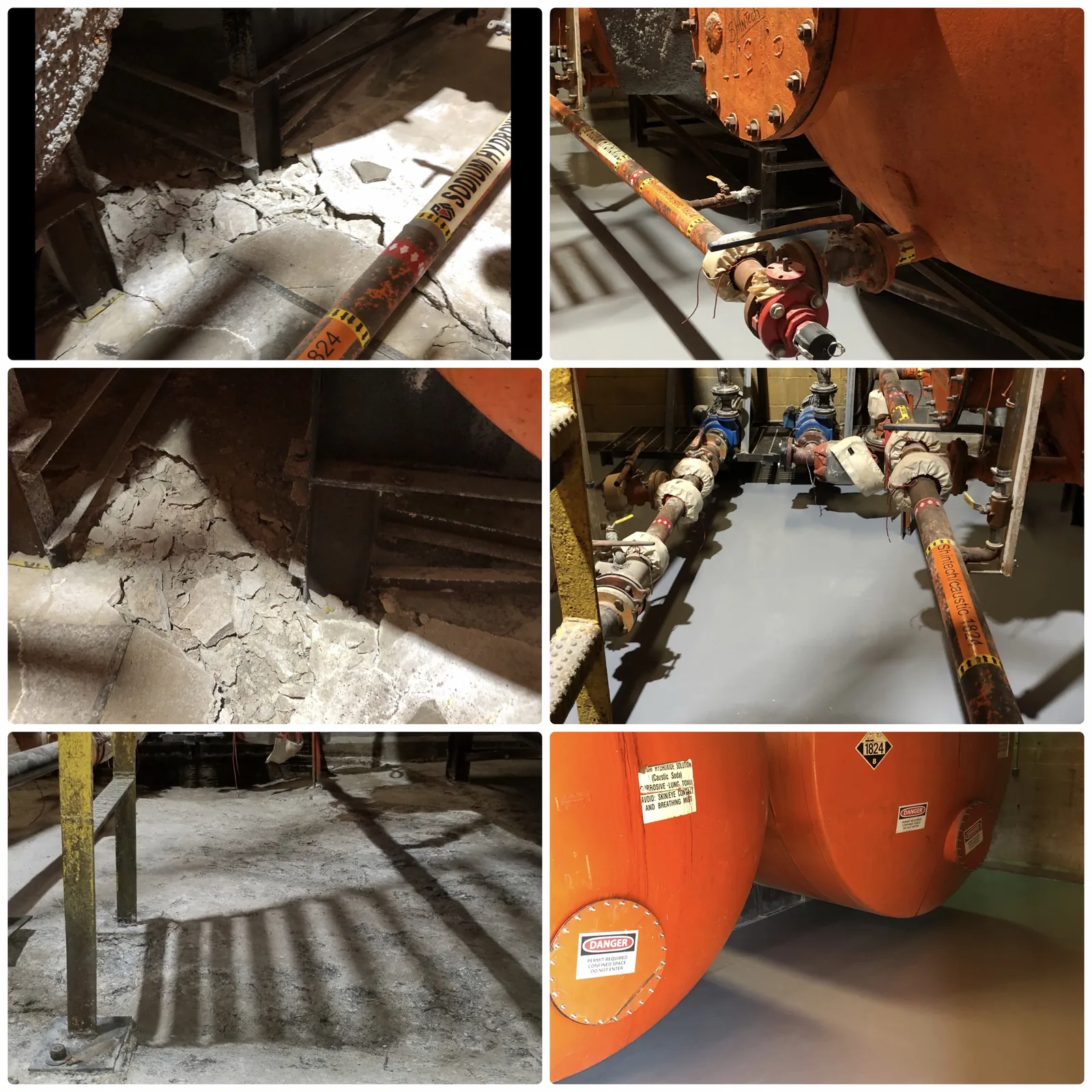
Caustic tank room: crumbling concrete under tanks and piping rebuilt and coated as a containment floor
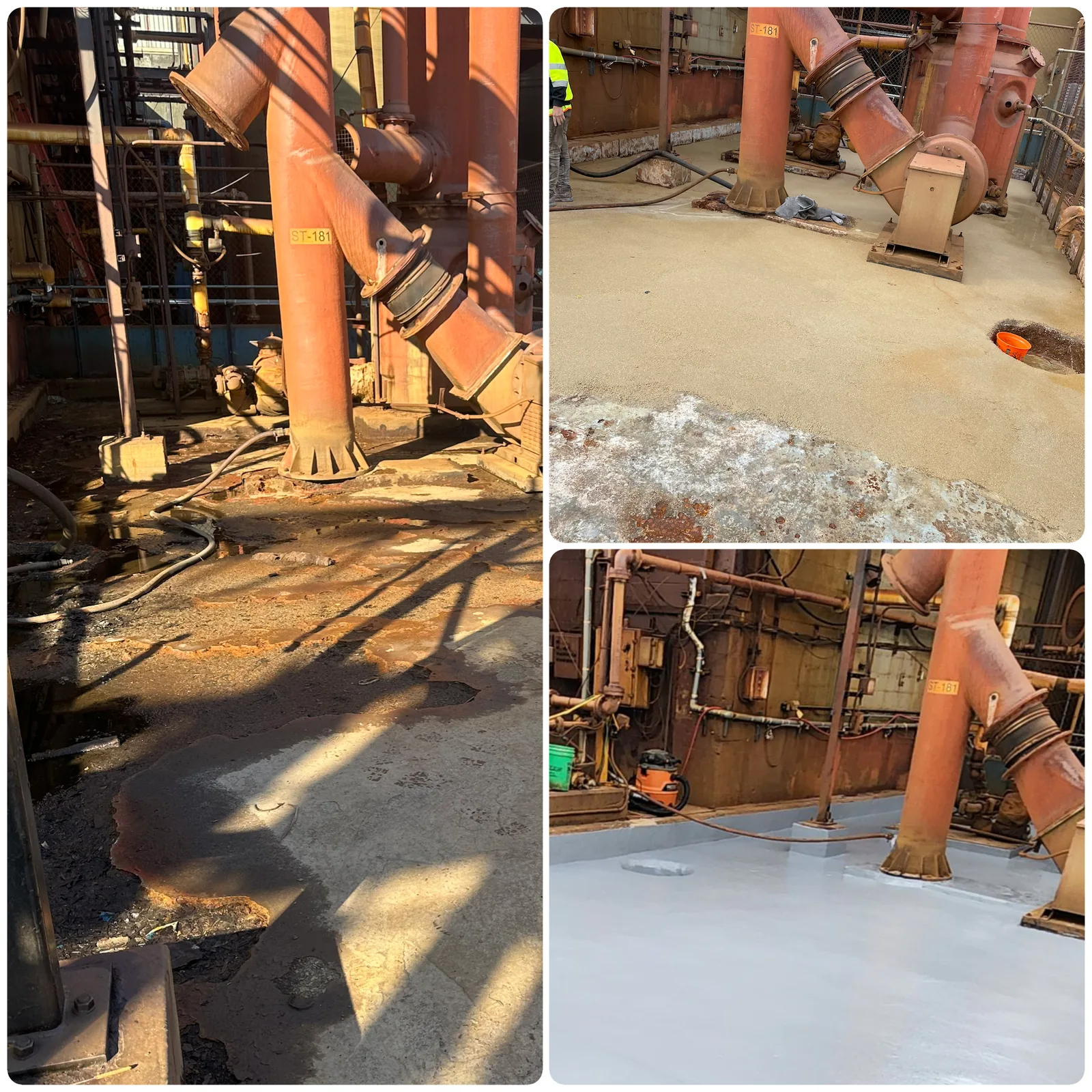
Containment pad around process equipment: deteriorated concrete rebuilt and coated, before and after
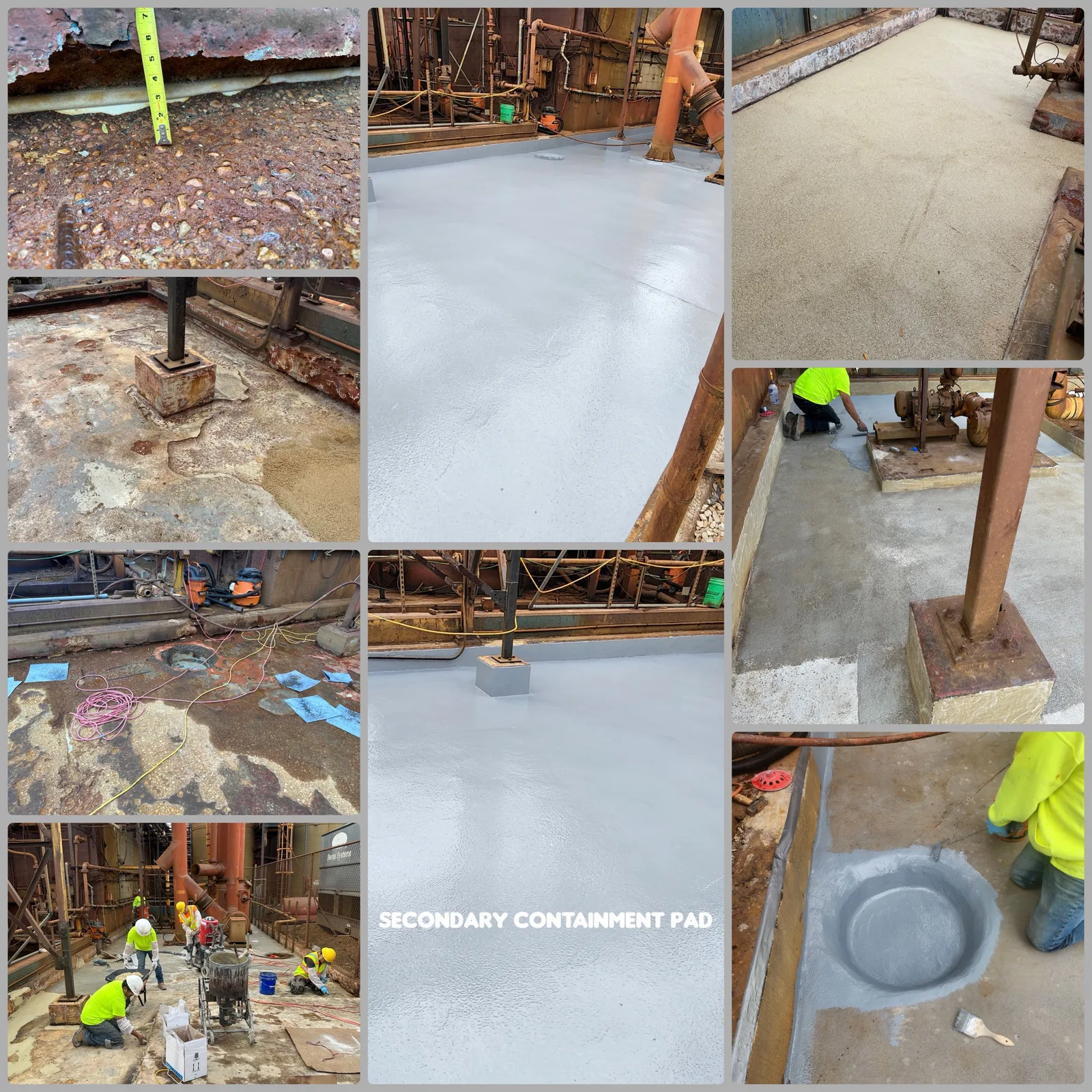
Secondary containment pad — before and after
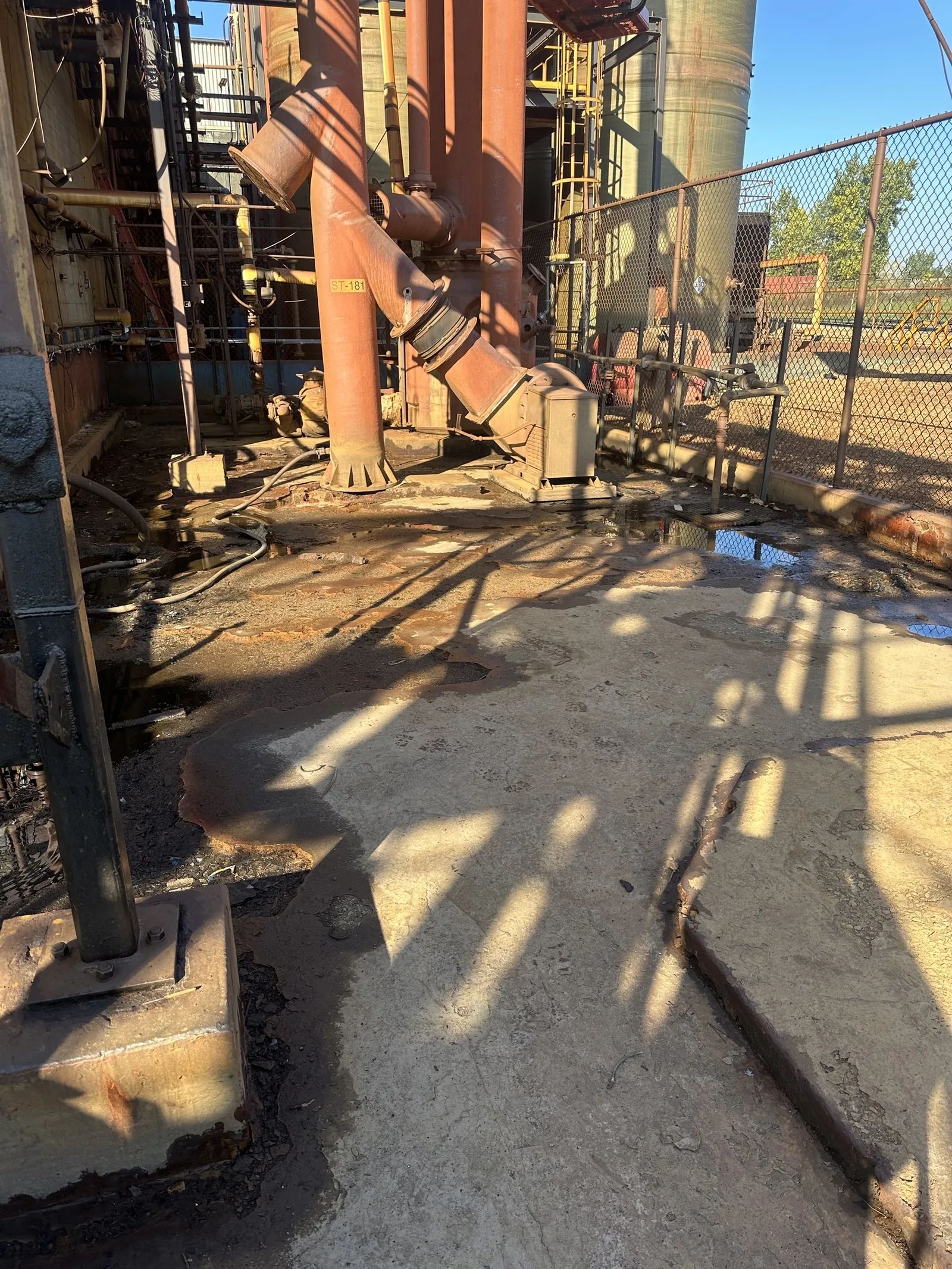
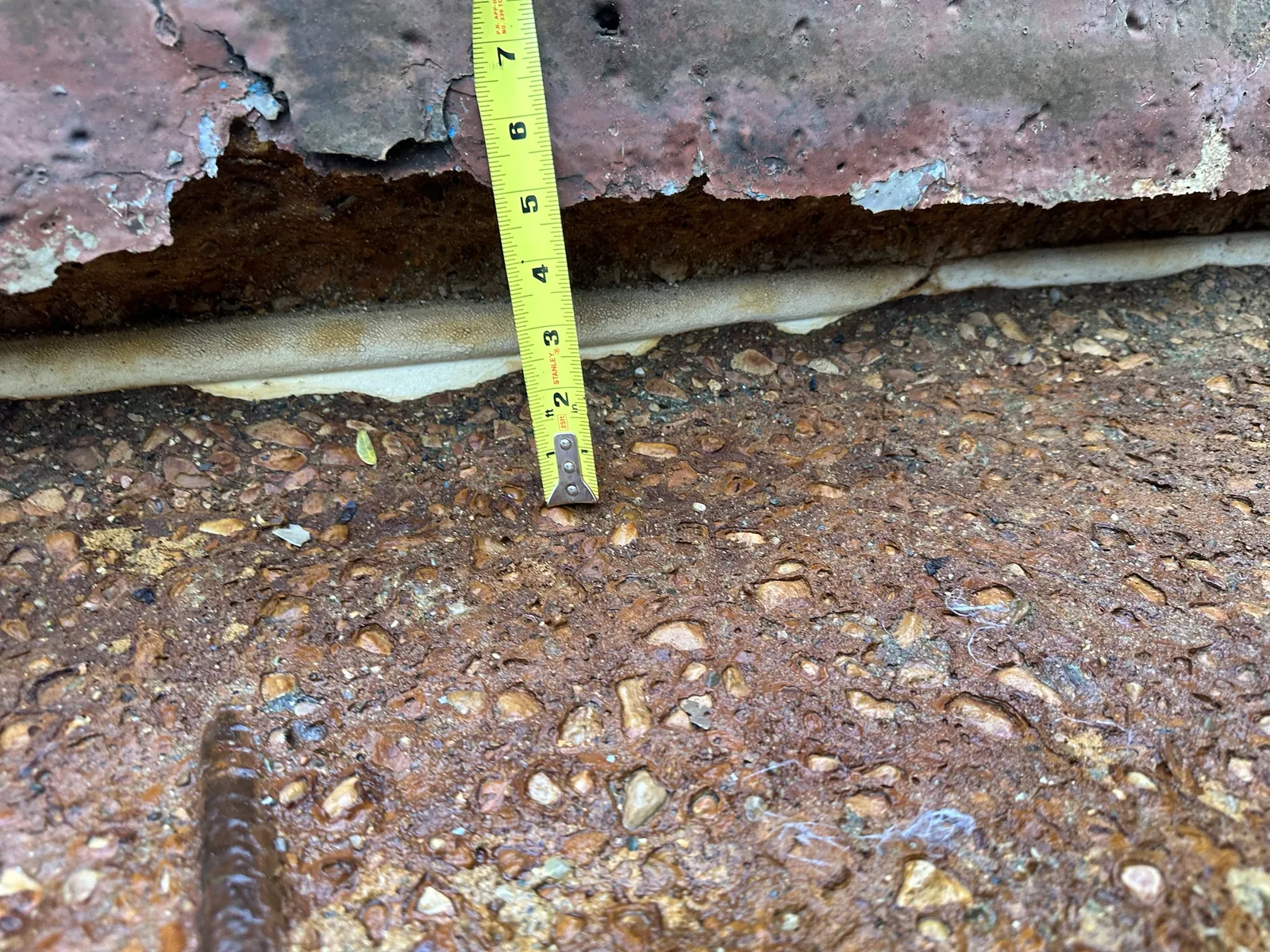
Before — etched pad and curb with severe section loss and exposed rebar
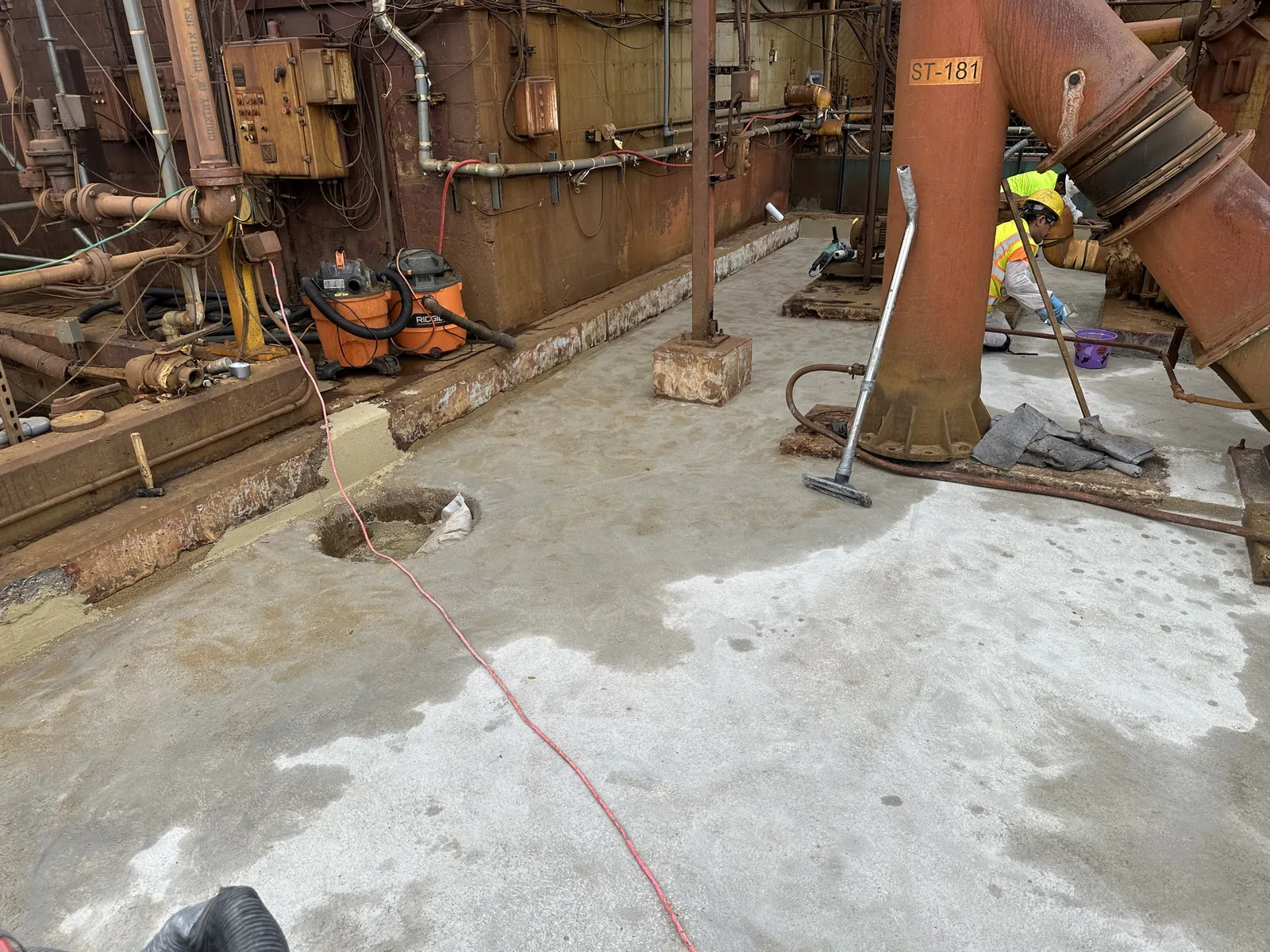
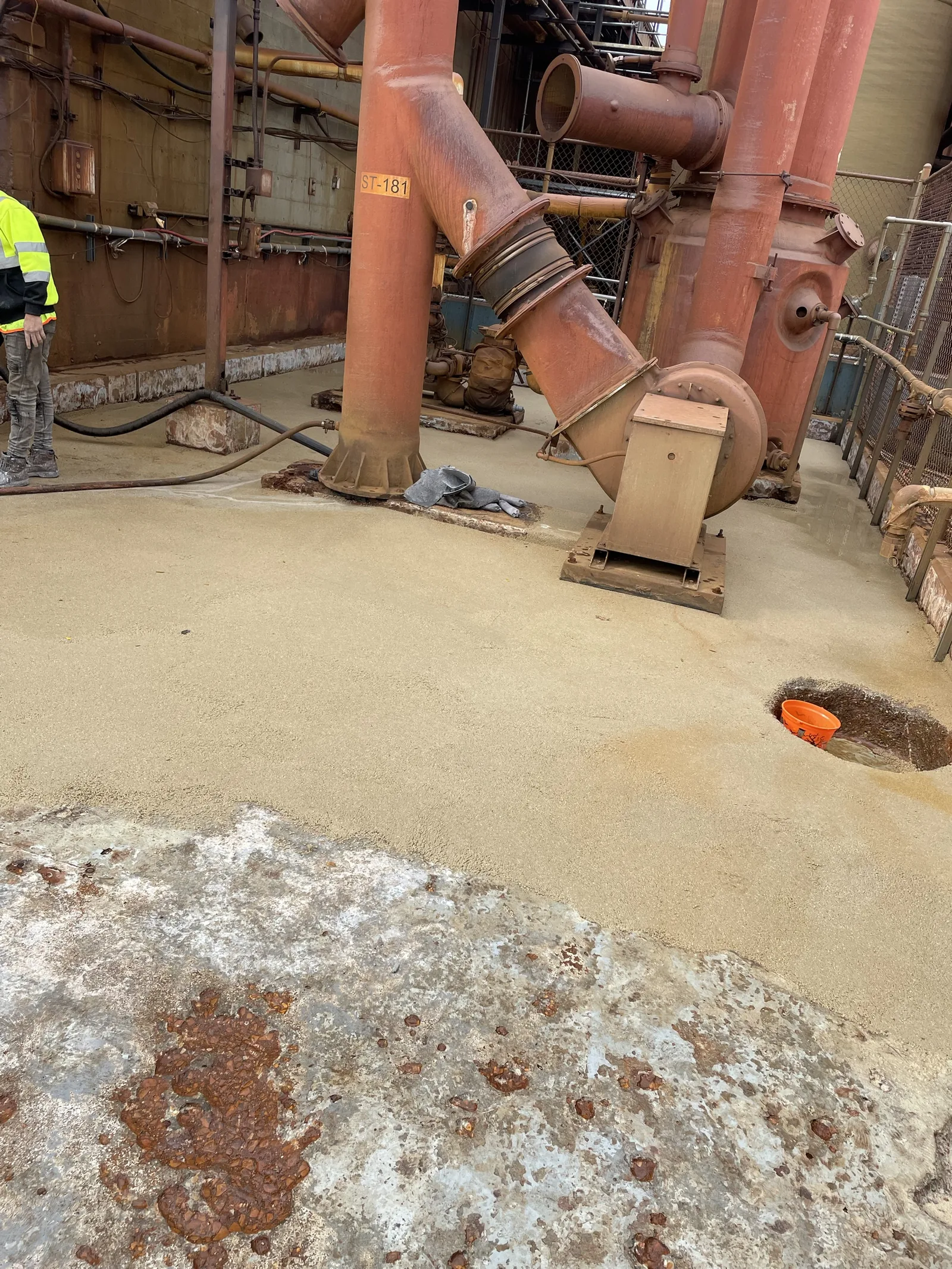
During — sump prepared to sound concrete; broadcast lining around the pump bases
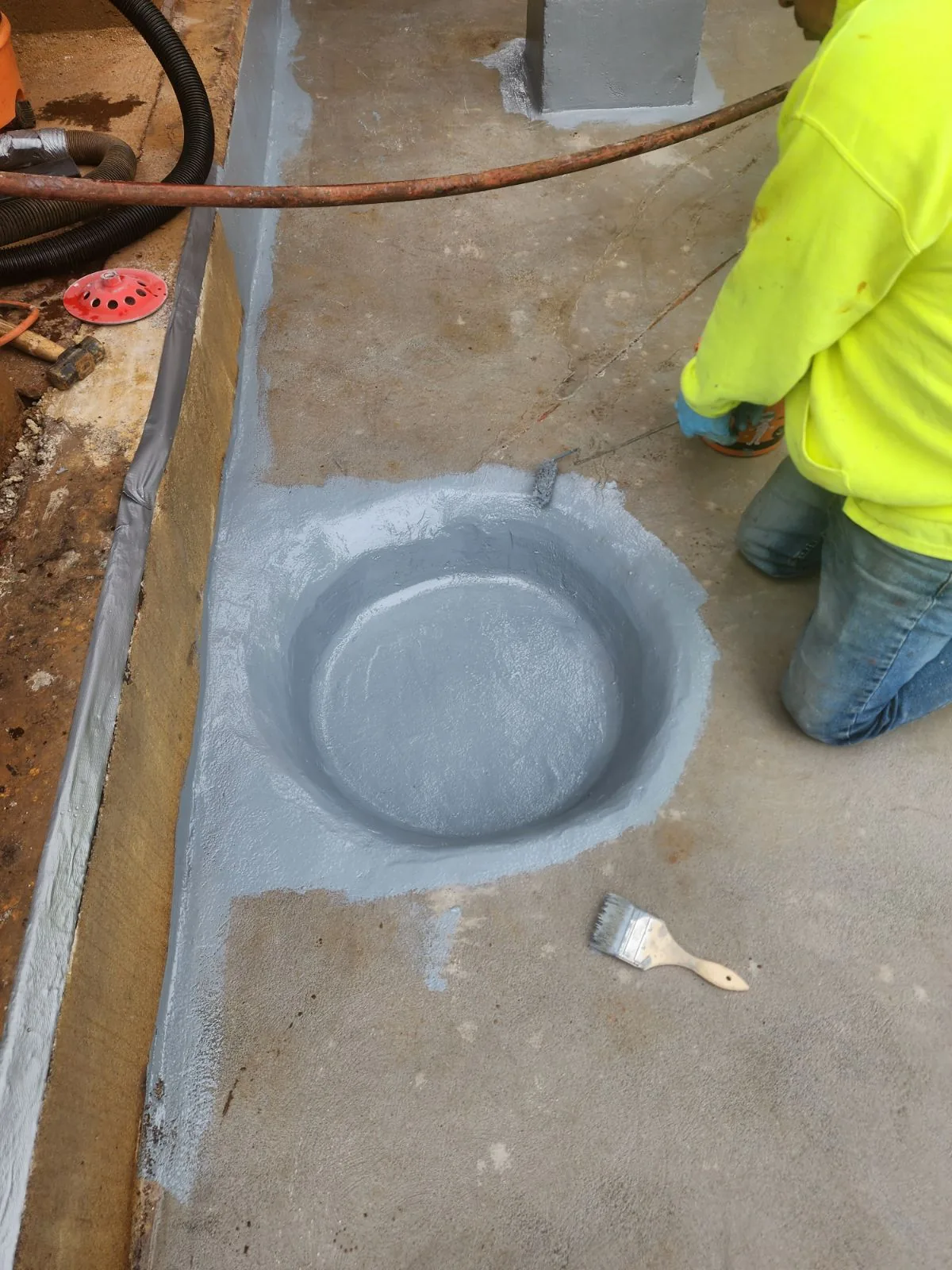
Detail — sump lined with coved, monolithic transitions
Straight Answers Before You Call
What is the difference between a chemical-resistant floor and secondary containment?
A chemical-resistant floor is built for incidental contact — a spill that is cleaned up, washdown, drips from a transfer line — plus the traffic and abuse of a working process area. Secondary containment is built to hold a release: a dike, curb, sump, or pit that keeps the stored chemistry in one place, at full concentration, until it is pumped out. The difference shows up in dwell time. A containment lining is specified for the chemistry sitting on it for hours or days, so the resin, the cove at the wall, the slope to the sump, and every termination are detailed for that condition rather than for traffic. Many plants need both, often in adjacent rooms.
Where do containment linings fail, and how do you build so they do not?
At the edges, almost never in the field of the floor. The cove where the pad meets the curb, the top of the curb, the corners of the sump, pipe sleeves and anchor bolts coming through the pad, and the joints are where chemistry finds concrete. Underneath all of them is the substrate: curbs and pad edges with severe section loss and exposed rebar, a pad that has lost its slope so a release stands instead of draining, and old coatings that were applied over unsound concrete. Maverick builds from the substrate up — concrete removed to sound material, section loss rebuilt, slope re-established — and then details the cove, curb face, sump, and every penetration as one monolithic lining with a vertical primer under the cove and semi-rigid filler in the joints.
Which resin handles concentrated sulfuric acid?
MavCoat NV. It is a 100% solids, zero-VOC novolac epoxy formulated for aggressive chemical environments, and its data sheet lists resistance to concentrated acids including 98% sulfuric acid and urea ammonium nitrate (UAN), with improved thermal shock resistance over conventional novolacs. In a containment build it goes over a MavClad EM troweled epoxy mortar body, or serves as the chemical-resistant topcoat over MavCrete UM where thermal shock or organic acids also govern. For dilute acids, caustics, and general plant chemistry, MavCoat CRE — a chemical-resistant epoxy with superior resistance over standard epoxies — is the usual starting point. The facility’s chemistry, concentration, and temperature are read against the chemical-resistance chart on each product’s data sheet before either one is specified.
How is the slope to the drain rebuilt before the lining goes down?
Acid-etched and spalled concrete is removed to sound material, chemically contaminated concrete is neutralized or removed, and the surface is mechanically prepared to the profile the system requires. Deep losses and off-slope areas are rebuilt with MavGrout USP, our urethane sloping and patching grout, so the finished lining falls to the sump or trench instead of ponding. Cracks and spalls are repaired with MavPatch Epoxy, or with MavRapidPatch and MavPolyPatch where the shutdown window is short. Joints are filled with MavJoint JF semi-rigid joint filler. The lining body, the vertical primer under the integral cove, and the topcoat go down only after the substrate is sound and draining.
Send Us the Chemistry. We Will Send Back the Lining.
Tell us what is stored or processed, at what concentration and temperature, and what the containment structure looks like today. We will scope the repair, the slope, and the lining it calls for, and a Maverick engineer will respond within 48 hours.